
Automatic PPE Detection for Workplace Safety
Automatic PPE detection linked with turnstiles and access control.
SENTINEL
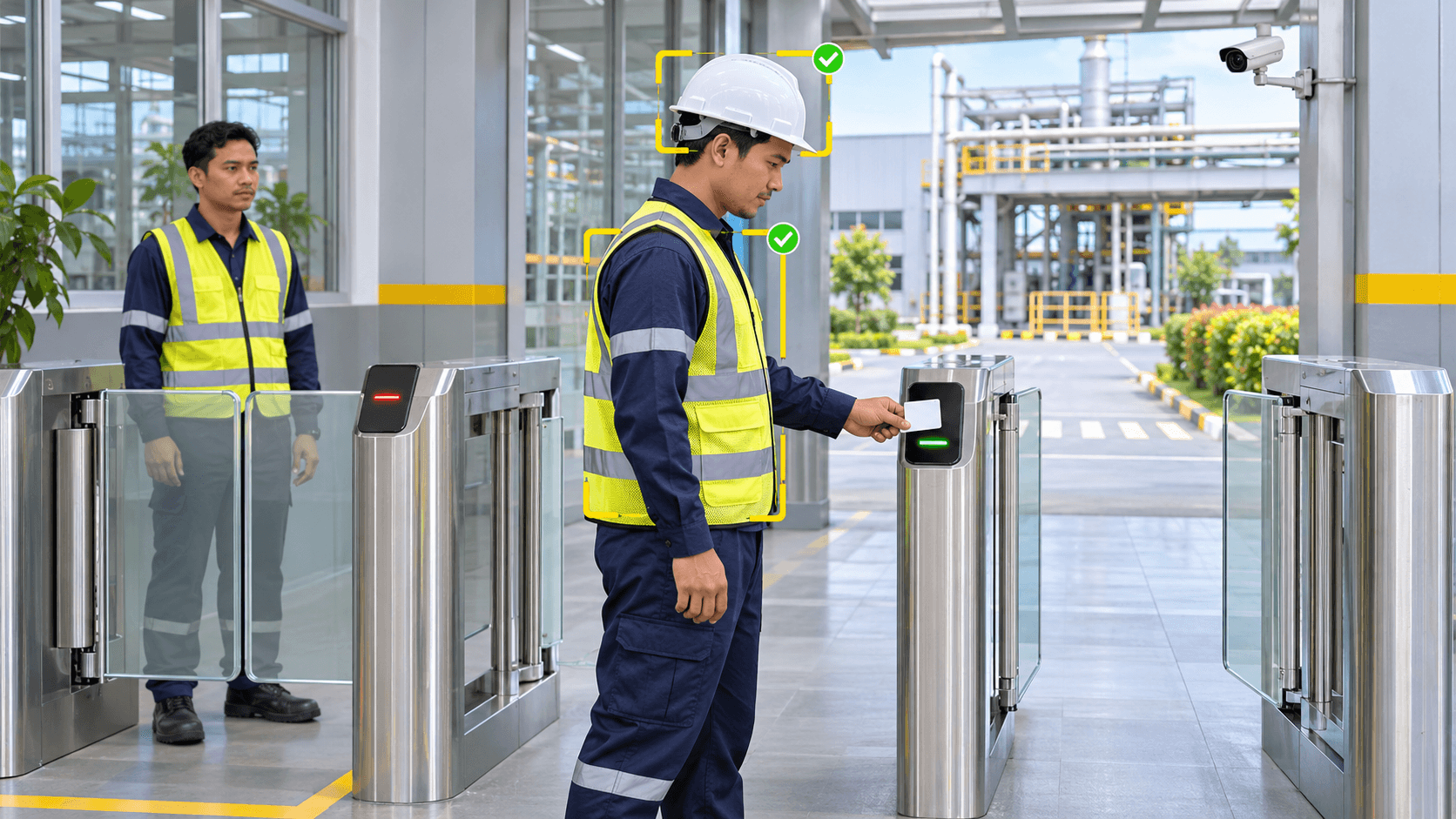
In 2025, Indonesia recorded more than 300,000 workplace accident claims, with 9,834 cases ending in death. The Minister of Manpower has stressed that worker protection cannot rely only on compensation after an accident, and must start with prevention. At the same time, each labour inspector oversees around 3,800 companies.
This means day-to-day workplace safety depends heavily on each company's own internal oversight. One of the most basic and hardest things to maintain is compliance with Personal Protective Equipment (PPE).
Why PPE compliance is hard to maintain
Almost every company already requires hard hats and safety vests. The challenge is in practice:
- Large work areas, few safety officers. One HSE officer cannot be in every area on every shift.
- Inspections are sampling-based. Checks happen at certain times, while violations can happen at any time.
- Daily habits. Hard hats come off because of the heat, and vests are left behind when someone steps into a work area "just for a moment".
- No data. Without records, it is hard to know which areas or shifts have the most violations.
Combining cameras with analytics and access devices in work areas can help close these gaps.
How automatic PPE detection works
AI video analytics Indonesia technology lets cameras check PPE use automatically.
- Cameras watch PPE-mandatory areas. For example, production area entrances, warehouses, construction zones, or mine sites.
- AI recognises people and checks PPE. AI Personal Protective Equipment analytics detect whether workers are wearing hard hats and safety vests.
- Instant alerts. When someone is not wearing PPE, the supervisor or HSE officer receives an alert with an image and the camera location.
- On-the-spot reminders. Alerts can be linked to a loudspeaker in the area so workers are reminded right away.
- Compliance reports. Every event is recorded, giving the company compliance data per area and per shift.
PPE as a condition of entry
PPE detection can be placed right at the entrance to PPE-mandatory areas and linked with access devices:
- Workers tap a card or verify their face at a card reader or face reader.
- A camera at the same point checks hard hats and vests.
- The turnstile or door only opens when PPE is complete. If not, the worker is reminded through a screen or loudspeaker.
- Everything is recorded. Access and PPE compliance data are stored together, so the company knows who is in the work area.
This approach prevents violations before they happen instead of only recording them. The integration is designed around the access control devices on site, and hardware needs can be supported together with partners.
Where it fits best
| Location | Example monitoring points |
|---|---|
| Factories and manufacturing | Production area entrances, machine areas, raw material warehouses |
| Warehouses and logistics | Forklift areas, loading docks, high racks |
| Construction | Site access points, work-at-height areas |
| Mining | Heavy equipment areas, workshops, mine entry posts |
| Oil and gas | Process areas, tanks, maintenance areas |
From alerts to data for improvement
The biggest benefit of PPE detection is not just the alerts, but the data it collects:
| Data | Use |
|---|---|
| Compliance rate per area | Identify areas that need more attention |
| Hours and shifts with the most violations | Schedule safety briefings and HSE patrols |
| Trends before and after a programme | Measure the success of safety campaigns |
| Event documentation | Material for internal reviews and HSE audits |
This data is best used for coaching, not only for discipline. Workers who understand that the system is there to protect them tend to build safe habits faster.
What about worker privacy?
PPE detection focuses on whether PPE is worn, not on who the person is. The system does not need to recognise faces to do this. If a company wants to link it to worker identity, for example through face recognition, personal data protection rules apply. Read Face Recognition for Businesses: Benefits and Indonesia's PDP Law.
More than PPE
The same platform can support wider workplace safety:
| Need | Relevant solution |
|---|---|
| Hazardous rooms open only to authorised workers | Access control with face readers, supported by Face Recognition & Search |
| People entering hazardous or restricted zones | Perimeter Intrusion Detection |
| Smoke and fire in production areas or warehouses | Fire & Smoke Detection |
| Monitoring many work sites from one place | Axxon One |
See industry examples on our Manufacturing and Mining pages.
How to get started
- Map PPE-mandatory areas. Identify the highest-risk points, such as production area entrances and heavy equipment zones.
- Check existing cameras and access devices. Make sure workers are clearly visible from head to torso, and note any turnstiles or readers already installed.
- Start with a pilot. Enable detection at a few points for 2–4 weeks to get baseline data.
- Communicate with workers. Explain the purpose of the system before full activation.
- Review data and expand. Use the reports in safety briefings, then add more areas.
Frequently asked questions
Do we need special cameras? Usually not. Installed IP cameras can be used as long as workers appear large and clear enough in the image. See also Upgrade Your Existing CCTV to AI Without Replacing Cameras.
What if hard hats or vests come in different colours? The analytics are trained to recognise the general shape of safety helmets and vests. Settings are tuned and tested during the pilot to match site conditions.
Does it work on night shifts? Yes, as long as the work area is well lit or the cameras have adequate night image quality.
Build a data-driven safety culture with SENTINEL
SENTINEL (PT Sentra Teknologi Inteligen) is the sole distributor of AxxonSoft in Indonesia. Our team helps you map PPE-mandatory areas, configure analytics, integrate them with turnstiles and access control, route alerts to your HSE team, and train operators. Instalment payment schemes are also available through our multifinance partners.
Book a free consultation to design a PPE detection pilot for your work site.
News sources (Indonesian): IndoTelko, 23 May 2026 · AFU.id, 5 August 2026