
AI CCTV Smoke and Fire Detection for Buildings and Factories
How AI CCTV spots smoke and fire early in buildings, factories and warehouses.
SENTINEL
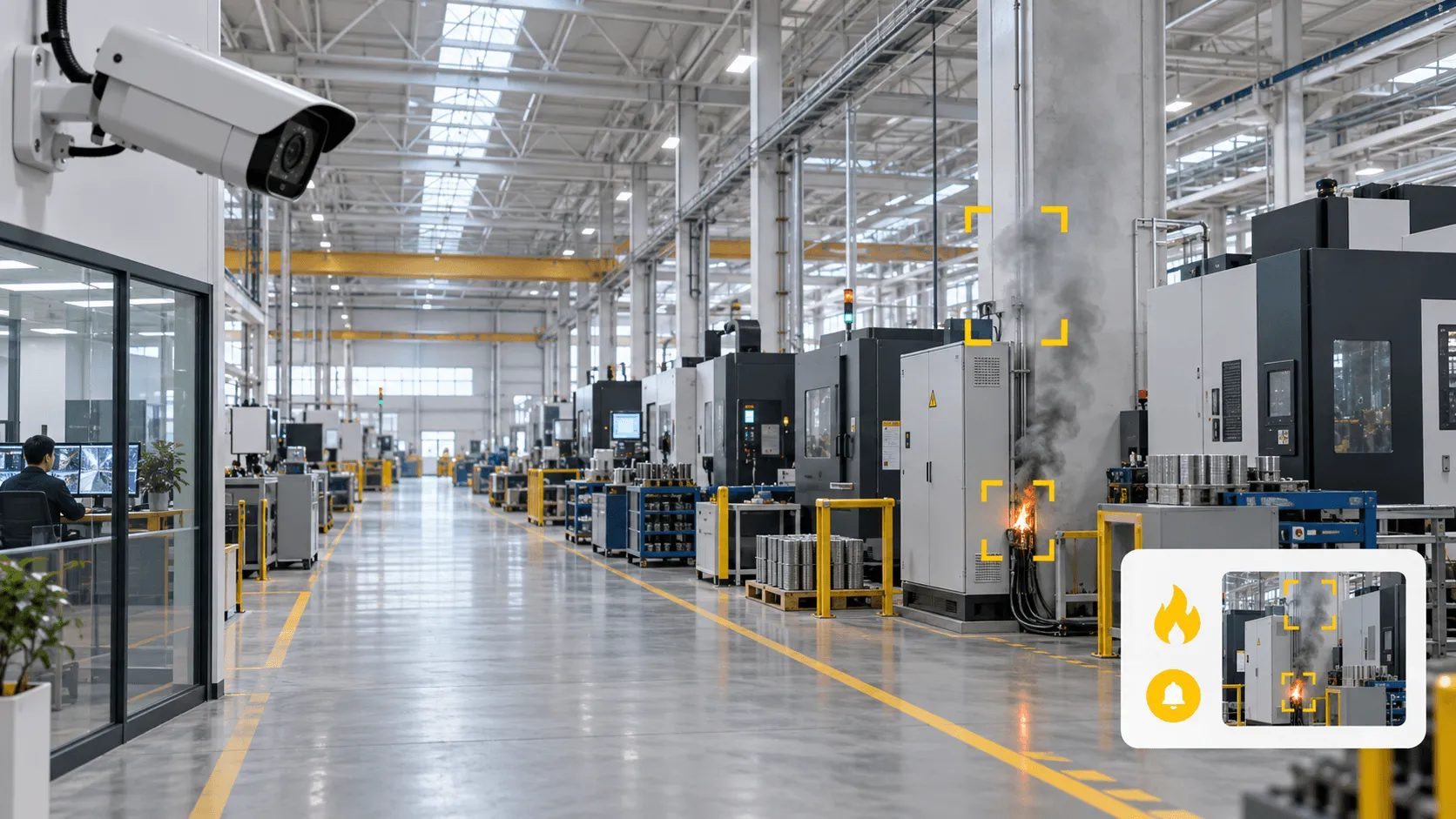
The 2026 dry season is a fresh reminder of how quickly fires can start. Between January and September 2026, Jakarta alone recorded 1,467 fires, with electrical short circuits as the leading cause. The Jakarta Regional House of Representatives has also asked that every building be equipped with early fire detection.
In buildings, factories, and warehouses alike, the lesson is the same: the sooner a fire is detected, the smaller the loss. A few minutes can decide whether a fire is put out with a portable extinguisher, or whether it needs many fire engines and halts operations for days.
Gaps in conventional detection
Smoke and heat detectors remain essential. But there are conditions where ceiling detectors respond more slowly:
- High ceilings. In warehouses or factories with ceilings over ten metres high, smoke takes time to rise and become dense enough to reach the detector.
- Open and semi-open areas. Loading docks, car parks, storage yards, or areas with strong airflow disperse smoke quickly, making it hard for detectors to pick up.
- No visual context. When an alarm sounds, staff do not yet know the exact location, how big the fire is, or whether it is a false alarm. Time is lost checking on site.
- Reliance on human attention. A control room with dozens of CCTV screens is hard to watch continuously, especially at night.
What is often missing is a set of eyes that watches every area 24 hours a day and alerts the moment the first smoke appears.
How AI CCTV smoke and fire detection works
AI video analytics Indonesia technology allows existing CCTV cameras to be analysed automatically by AI.
- Cameras watch high-risk areas. For example, electrical panel rooms, production floors, storage racks, loading docks, or basement car parks.
- AI recognises smoke and fire. Fire & Smoke Detection analytics recognise rising smoke and flames directly from the video image, often before smoke reaches a ceiling detector.
- Instant alerts to the operator. The control room receives an alert with a video clip and the camera name, so the location is known straight away.
- Verification in seconds. The operator checks the video to confirm whether it is a real incident, then starts the emergency response procedure.
- Recordings for review. Every event is stored with its time and footage, useful for investigating causes and improving procedures.
AI CCTV complements, rather than replaces, existing smoke detectors, sprinklers, and fire alarms.
Where it helps most
| Location | Example areas to monitor |
|---|---|
| Warehouses and logistics centres | High racks, forklift charging areas, loading docks |
| Factories and manufacturing | Production floors, electrical panel rooms, flammable material storage |
| Office buildings and malls | Basement car parks, service areas, food court kitchens |
| Hospitals and public facilities | Utility rooms, storage areas, service corridors |
| Outdoor areas | Storage yards, waste collection points, generator areas |
Reducing false alarms
A common concern is false alarms. Kitchen steam, dust, vehicle exhaust, light reflections, or flashing lamps can resemble smoke or fire. Ways to keep detection accurate:
- Set detection zones. Focus analytics on the areas that truly need watching and exclude sources of interference such as steam vents.
- Tune sensitivity per camera. A kitchen and a dry warehouse do not need the same settings.
- Operator verification. Because every alert comes with video, the operator can confirm within seconds.
- Regular review. Review alerts during the first few weeks, then fine-tune the settings.
More than fire
The same cameras and platform can support other safety and security needs:
| Need | Relevant solution |
|---|---|
| Worker PPE compliance on the production floor | AI Personal Protective Equipment |
| Intrusion into restricted areas or fences | Perimeter Intrusion Detection |
| Vehicles entering and leaving gates | License Plate Recognition |
| Monitoring many buildings or branches from one place | Axxon One as a central platform |
How to get started
- Map fire-prone points. Start with electrical panel rooms, storage areas, and places that have had incidents before.
- Check your existing cameras. Many installed IP cameras can be used right away, often with only a change of viewing angle.
- Start with a pilot. Enable smoke and fire detection on a few cameras, then measure detection speed and false-alarm rates.
- Connect alerts to your emergency procedure. Decide who receives alerts, who verifies, and who goes to the location.
- Expand step by step. Once proven, add more areas and buildings.
Frequently asked questions
Do we need to replace all our CCTV cameras? Usually not. The analytics run on the server, so installed IP cameras can typically be used as long as image quality and viewing angles are adequate.
Does it work at night? Yes, as long as the area is visible to the camera. For very dark or outdoor areas, thermal cameras can complement the system.
Can it connect to our existing systems? Alerts can be sent to the control room or to operators' mobile apps, and integrated with other systems depending on project needs.
New to CCTV management systems? Read What Is a VMS? A Guide to Choosing CCTV Software for Companies and What Is AI Video Analytics? A Guide for Companies in Indonesia.
Build an early detection system with SENTINEL
SENTINEL (PT Sentra Teknologi Inteligen) is the sole distributor of AxxonSoft in Indonesia. Our team helps you map high-risk points, choose the right analytics, design servers, and train your operators. Instalment payment schemes are also available through our multifinance partners.
Book a free consultation to design a smoke and fire detection pilot for your building or facility.
News sources (Indonesian): RMOL, 23 October 2026 · ANTARA, 23 September 2026