
What Is AI Video Analytics? A Guide for Companies in Indonesia
How AI video analytics works and how to start with the CCTV you already own.
SENTINEL
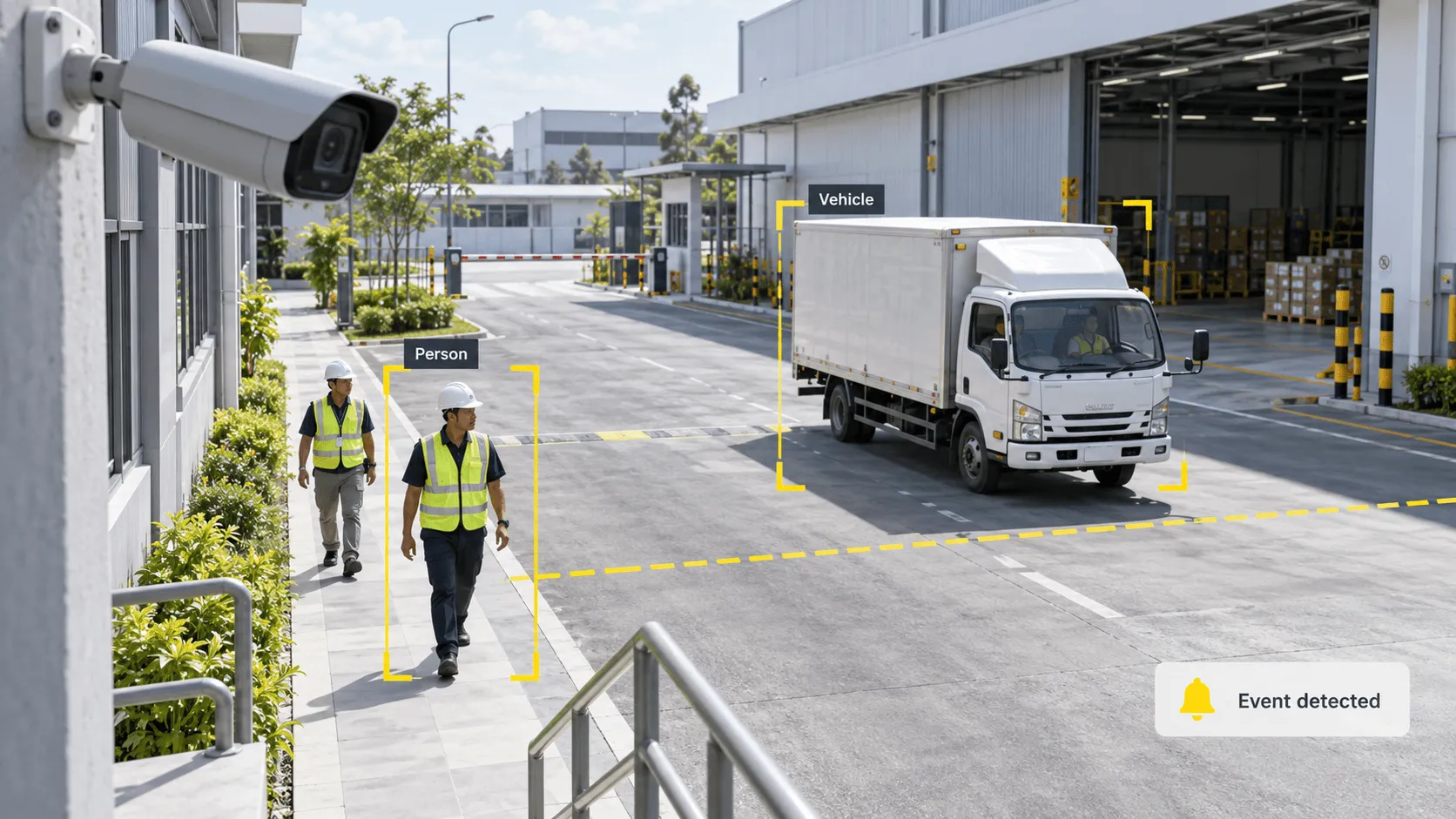
Every day, thousands of CCTV cameras in offices, factories, malls, and mine sites across Indonesia record without pause. The problem is that almost all of that footage is only watched after something has happened. No security officer can stare at dozens of screens for an entire shift, and finding one incident in hours of recordings can take a whole day.
This is where AI video analytics comes in. It turns CCTV from a passive recorder into a system that understands what is happening in front of the camera and alerts your team the moment it matters.
What is AI video analytics?
AI video analytics is software that analyses camera feeds automatically using artificial intelligence. Instead of simply storing images, it recognises objects and behaviour in the video: people, vehicles, faces, licence plates, smoke, or crowds.
The result is information your team can act on straight away: an alert when someone enters a restricted area, a report of visitors per hour, or a log of vehicles passing through a gate.
How does it work?
In simple terms, there are three stages:
- The camera captures the image. Most modern systems can use IP cameras you already have, including cameras from different brands.
- AI analyses every frame. Trained neural network models recognise objects, count them, and compare patterns against the rules you set, for example "alert me if anyone is in this area after 10 pm".
- The system takes action. An alert appears on the operator's screen or phone, the event is marked in the recording, and the data is collected in a dashboard for reporting.
Analysis can run on local (on-premise) servers or on edge devices, so sensitive footage does not have to leave your company network.
The most widely used capabilities
These are the AI video analytics functions companies in Indonesia use most often:
- Face Recognition & Search: recognise employees, visitors, or people on a watchlist, and find where a person appeared across all cameras in seconds.
- License Plate Recognition: read vehicle licence plates automatically at gates, car parks, or access roads.
- Fire & Smoke Detection: detect smoke and flames visually, often earlier than conventional smoke detectors in large or open spaces.
- Perimeter Intrusion Detection: raise an alert when a person or vehicle crosses the boundary of a protected area.
- People Counting and Heatmap: count visitors and map the busiest areas, especially useful for retail and commercial buildings.
- AI Personal Protective Equipment: check PPE compliance such as helmets and vests in factories or mine sites.
- MomentQuest: forensic search that finds specific events in recordings by colour, direction of movement, object size, or area, without replaying hours of video.
Conventional CCTV vs CCTV with AI
| Aspect | Conventional CCTV | CCTV with AI video analytics |
|---|---|---|
| How it works | Records, then a person reviews it | Analyses automatically in real time |
| Incident response | After the event, when footage is checked | Instant alert while the event is happening |
| Searching footage | Manually replaying video | Search by face, plate, colour, or object |
| Business data | None | Visitor counts, queues, busy areas, regular reports |
| Operator workload | High, easy to miss things through fatigue | Operators focus on the events that truly matter |
Benefits for companies
More proactive security. Threats are detected while they are happening, not discovered the next morning. Security teams can respond faster with clear information: what happened, where, and when.
Measurable workplace safety. PPE violations, people in hazardous zones, or early signs of fire can be detected and reported automatically, so safety programmes are backed by data rather than periodic inspections alone.
Operational efficiency. Camera data supports business decisions: when a store is busiest, how long checkout queues last, or how heavy vehicle traffic is at a factory gate.
More value from existing cameras. Cameras already installed can do much more without replacing them all. In many projects, adding the right software and servers is enough.
Examples across industries
- Retail: count visitors, map busy zones, and help prevent shrinkage.
- Manufacturing: monitor PPE compliance and restricted zones on production lines.
- Mining and Oil & Gas: perimeter protection for large areas, early fire and smoke detection, and vehicle monitoring.
- Smart buildings: face recognition access, licence plate parking, and one dashboard for every camera.
- Airports: crowd estimation, abandoned object detection, and perimeter security.
What to consider before you start
Before choosing a solution, it is worth confirming a few things:
- Define the problem you want to solve. Start with one or two priorities, such as gate security or PPE compliance, then expand step by step.
- Check camera quality and placement. AI accuracy depends heavily on resolution, lighting, and camera angle. A site survey shows which cameras are already good enough.
- Size your servers. Each type of analytics needs different processing capacity. Proper planning prevents a slow system or unnecessary cost.
- Respect personal data protection. Face and licence plate data are personal data. Make sure your deployment follows Indonesia's Personal Data Protection Law (Law No. 27 of 2022), including notifying people who are recorded and controlling who can access the data.
- Make sure local support is available. Implementation, operator training, and technical support in the same language and time zone make a big difference to a project's success.
Getting started with Axxon One
Axxon One is AxxonSoft's video management system (VMS) platform that combines camera management and AI video analytics in one system. It supports cameras from many brands, so companies can start from their existing infrastructure and add analytics as needed. Learn more on our Product and Solution pages.
SENTINEL (PT Sentra Teknologi Inteligen) is the sole distributor of AxxonSoft in Indonesia. Our team supports you from needs mapping and site surveys to implementation and on-site training. To make the investment easier, instalment payment schemes are also available through our multifinance partners.
Want to know which analytics fit your site best? Book a free consultation with the SENTINEL team.